For COST Actions and research consortia · GSS methodology series 02 of 03
A structured method for turning a stakeholder list into a prioritised, MoU-anchored engagement plan, and for getting your whole team to own it rather than one person.
Designed around COST Action MoU deliverables, and it applies to any research consortium carrying impact, dissemination and exploitation obligations.
The problem
Not because anyone is careless, but because the usual approach produces something that cannot be revisited, defended or acted on.
The framework
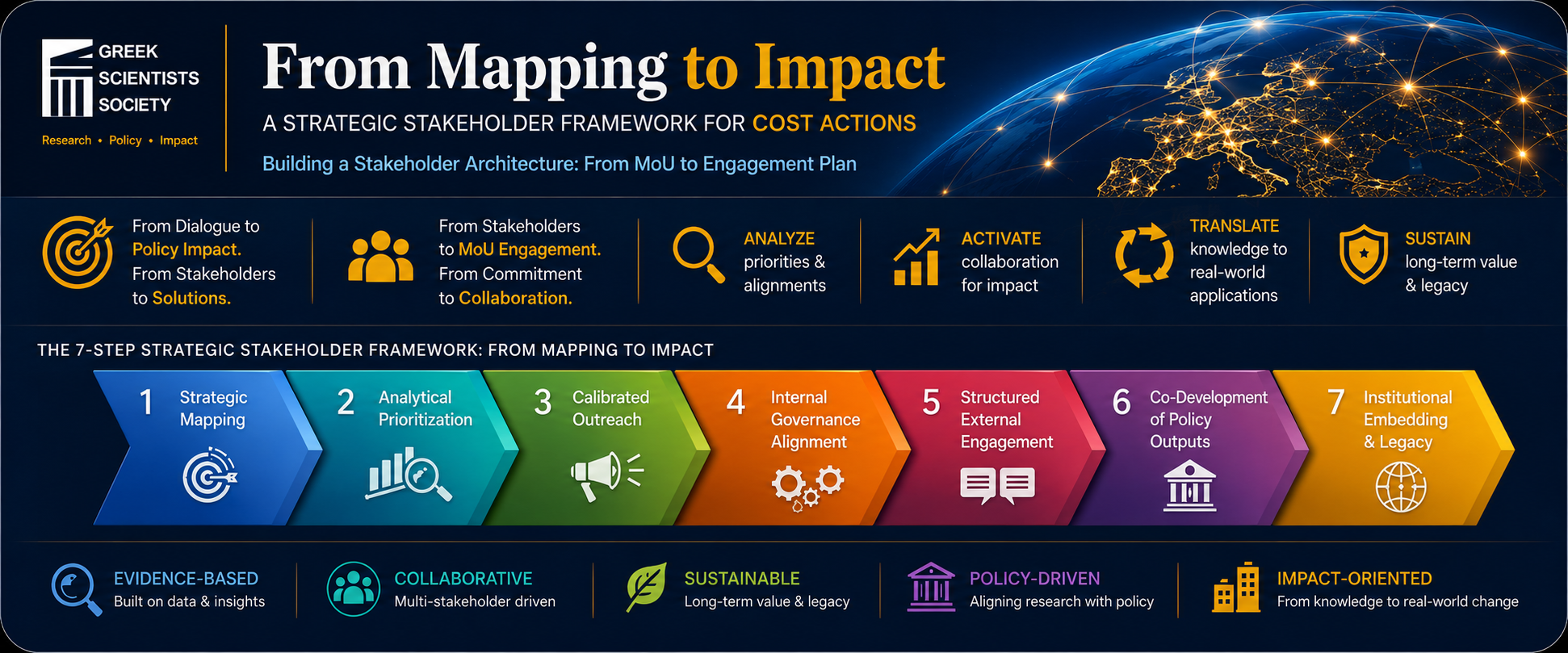
The name carries the argument. Mapping tells you who exists. Impact needs six further things, from prioritising analytically through to embedding the work in institutions that outlast the Action.
Developed by the Greek Scientists Society and applied across COST Actions in health, environment, energy and agri-food. The method is domain-agnostic: the instruments stay the same, only the register and the MoU behind it change. A companion method, From MoU to Legacy, carries the same stakeholders into post-Action sustainability planning.
Build the register from the Memorandum of Understanding itself. Every stakeholder is traced to a section and flagged as cited, implied, or an analytical addition. The quadruple helix acts as a completeness check against the natural pull toward familiar academic contacts.
Score each stakeholder through established instruments: salience, power and interest, influence and impact, engagement position, and a SWOT of the relationship. Normalise them to one scale, weight them, and let the tiers follow. No single lens is sufficient, so they triangulate.
Match the approach to the stakeholder rather than sending everyone the same thing. Each constituency gets its own key message, channel, frequency and named owner, so outreach is proportionate to what the relationship is actually for.
Engagement fails when it belongs to one enthusiast. The working groups, the coordinating team and the governing committee each take a defined part, so the plan is owned inside the consortium's own governance and survives any individual stepping back. It also means external stakeholders meet one coordinated project rather than several uncoordinated approaches.
Convert priority into a calendar. Each constituency gets a scheduled round tied to the Action's milestones, so contact is sequenced and deliberate rather than opportunistic, and nobody important is reached for the first time in the final year.
Stakeholders help produce the outputs rather than receiving them once finished: policy briefs and position papers, roadmaps, contributions to standards and guidelines, training material, and responses to consultations. Adoption follows authorship, and a document written with its audience is far harder for that audience to ignore.
Identify what must outlive the Action and which institutions will anchor each pillar, then start the handover while the network still has momentum and funding. This is where a four-year project becomes a durable structure rather than a closed file.
 Watch on YouTube
The framework, in short
From mapping through to a sequenced engagement plan.
Watch the video →
Watch on YouTube
The framework, in short
From mapping through to a sequenced engagement plan.
Watch the video →
 Coming soon
From MoU to Engagement Plan
The method, the analysis and the workspace, walked through in full.
Coming soon
Coming soon
From MoU to Engagement Plan
The method, the analysis and the workspace, walked through in full.
Coming soon
 Demonstration
See the working instrument
The Insect-IMP scoring workspace, fully configurable: six weights, four thresholds, and a ranking that moves as you change them.
Open the demonstration →
Step by step
Instructions for participants
What the team is asked to do, and how the workspace is used.
Read the instructions →
Demonstration
How contributions are compared
A demonstration, with illustrative data, of the consolidated view.
See the demonstration →
Demonstration
See the working instrument
The Insect-IMP scoring workspace, fully configurable: six weights, four thresholds, and a ranking that moves as you change them.
Open the demonstration →
Step by step
Instructions for participants
What the team is asked to do, and how the workspace is used.
Read the instructions →
Demonstration
How contributions are compared
A demonstration, with illustrative data, of the consolidated view.
See the demonstration →
What sits inside
Used together they triangulate, because each one is blind to something. Salience tells you who is legitimate and urgent, but not whether your deliverables depend on them. Influence and impact tells you who carries weight, but not whether they care. The engagement spectrum tells you how far a relationship has to travel, but not whether the journey is worth making. SWOT tells you the character of a relationship, but not its rank. The combined index is what reconciles them, and the weights are yours to set.
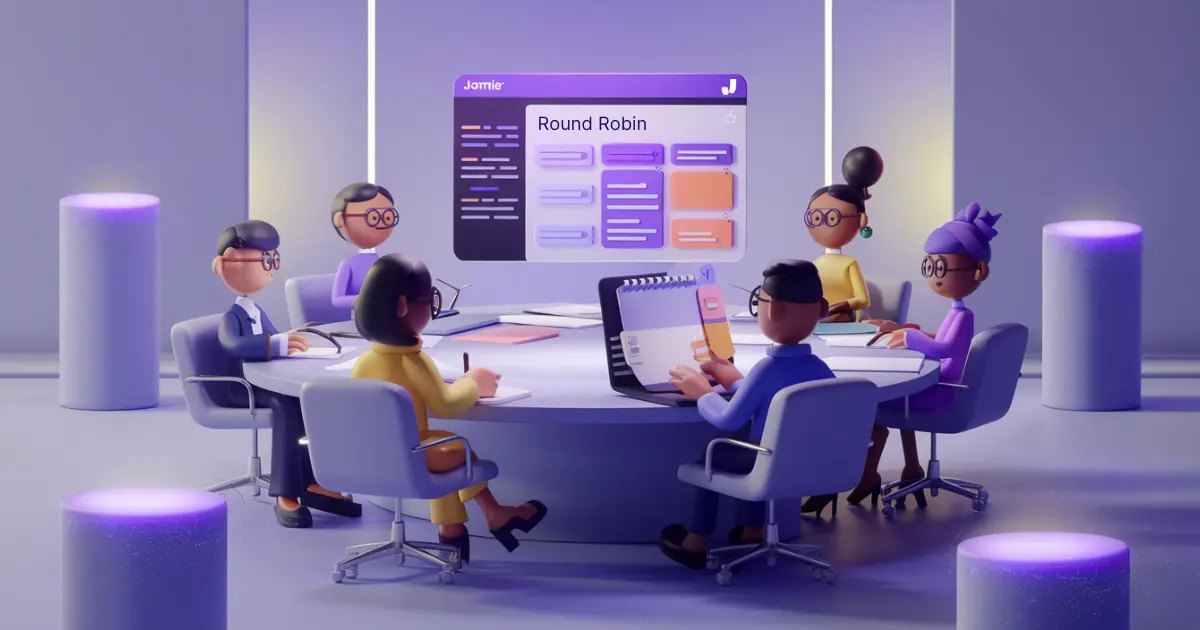 Round robinA structured turn-taking format: each constituency gets its own scheduled round, with its own core question and its own output, rather than ad-hoc contact.Read more on meetjamie.ai →
A worked example
A full analysis and engagement plan, published in full so you can judge the output rather than the description. Every one of the forty stakeholders is traced back to the Action's MoU.
It is fully configurable, and that is the point rather than a feature. Six weights combine the instruments into one score, and four thresholds set the tiers. All ten are visible and editable. Change one and the ranking, the tiers and the radars re-order immediately.
This changes the character of the argument. A disagreement about priorities is vague and can run for a year. A disagreement about a weight is specific, visible, and settled in a single sitting. The team sets the model rather than receiving it, which is also what makes them defend the result afterwards.
Open the interactive analysisChange one rating and the classes, quadrants, index, tiers, shortlist, radars and dashboard all re-compute. Nothing falls out of step.
Making it the team's
However careful the analyst, a single set of judgements carries a single set of blind spots. So the analysis is paired with a workspace where the whole team scores the same stakeholders independently.
The live example is configured with Insect-IMP's forty stakeholders. For another Action it is rebuilt around its own register and MoU.
Members open a link, with no installation or account, and score the same stakeholders through the same lenses. Definitions, academic sources and explainers are built in. That is what makes judgements comparable; views gathered around a table never are.
Everything the Action knows on one page, with a comment box under each section. If a contact has changed or a strategy looks wrong, it is recorded where it belongs, the moment it is noticed.
Contributions are placed side by side per stakeholder with the spread flagged and each person's reasoning shown. Averaging a five and a three into a four would erase exactly the disagreement worth discussing.
 The workspace as a member sees it: the ranked register on the left, the scoring lenses on the right.
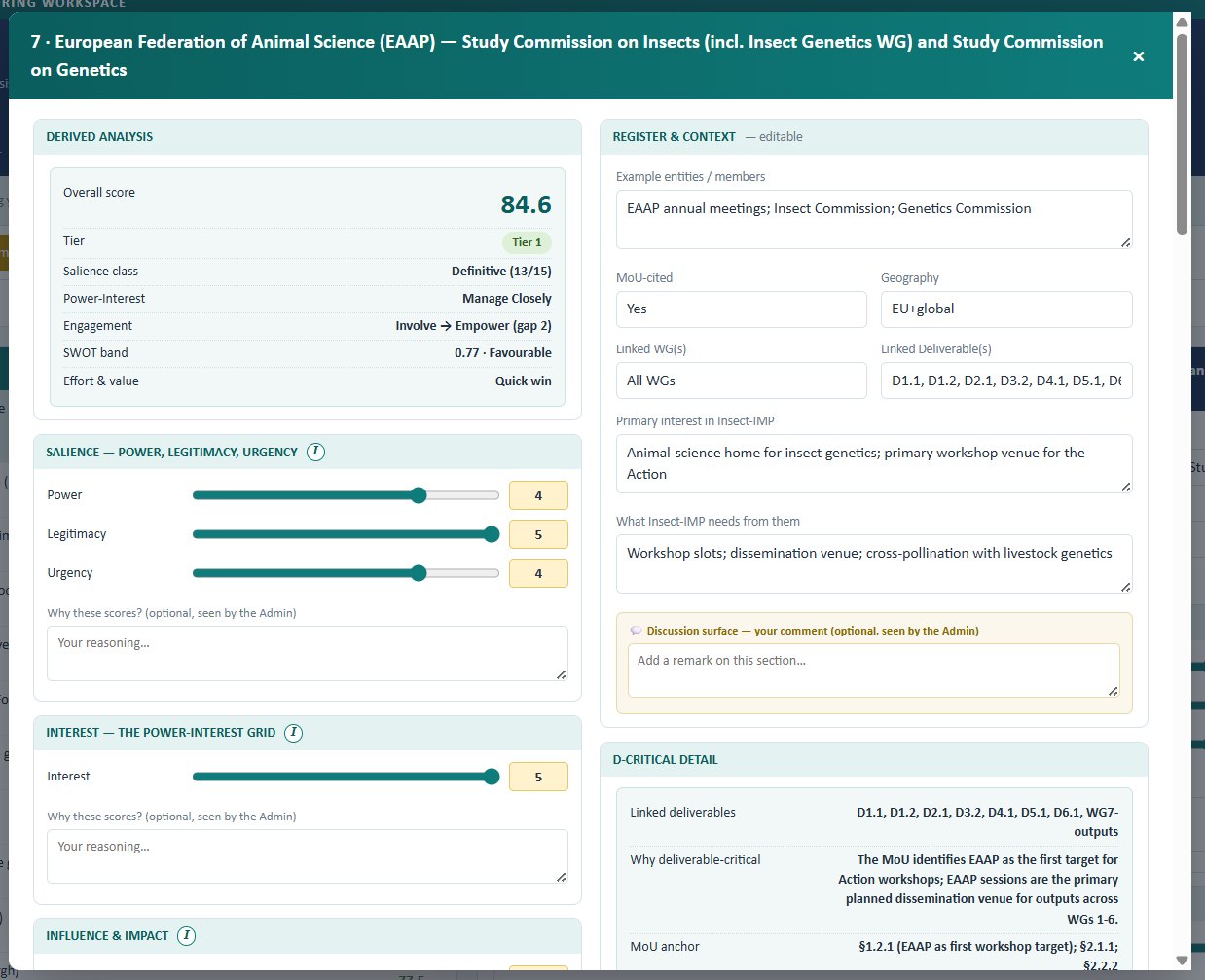 Each stakeholder opens as a full page: the scoring on the left, the register and the reasoning on the right.
How it runs
Building and scoring the register is the predictable part. Everything after it depends on the network: how quickly people contribute, and when the group can next meet. It works from the published Memorandum of Understanding or Grant Agreement, with as much or as little direct contact as suits the consortium.
Typically funded through a COST Virtual Mobility grant, which is designed for exactly this kind of remote collaborative work.
Every stakeholder traced to a section, classified, and linked to Working Groups and deliverables.
Salience, both grids, engagement positions, SWOT, risk and sustainability, producing a first prioritised view.
Stakeholder team members, Working Group leaders and members, and invited external stakeholders each score the same register in the workspace.
Every contribution is placed side by side, stakeholder by stakeholder, with the spread flagged wherever assessments diverge sharply and each person's written reasoning shown beside their scores. Nothing is averaged: a five and a three do not become a four, because that would hide the disagreement worth discussing.
Weights and thresholds set live, in the room. The ranking re-orders while the group watches.
An open interactive analysis, the working file, a sequenced engagement plan, and the sustainability map.
When it pays off
Engagement is infrastructure, so the earlier it exists the more of the Action's life it can shape. But it earns its place at every stage, for different reasons.
The register comes straight out of the MoU you have just written, so the work is at its easiest and shapes everything after it. Outreach starts against a named, prioritised audience rather than whoever happens to be in the room, and the working groups know from the outset who they are producing for.
This is when relationships have to move from informing people to working with them. The analysis shows how far each relationship has to travel and what the first step is, so stakeholders can be brought into producing the briefs, roadmaps and standards rather than receiving them finished.
Whatever succeeds the project needs anchor institutions, and they have to be organisations already engaged rather than approached at the end. Naming them while the network still has momentum is what makes the transition credible rather than improvised.
What follows the register
The register is what makes outreach defensible. It is not outreach.
Each prioritised actor is approached with a specific ask, a clear statement of what they gain, and a reason the timing suits them. High influence actors are approached personally, technical actors thematically, regulators with a policy relevant proposition.
The first working encounter, hosted where the Action already meets. Among others: a thematic workshop for policy validation, a training school for technical harmonisation, a targeted roundtable for high level dialogue, a session within an Action meeting, or a policy sandbox where a rule can be tested before it is written.
A small drafting group produces something usable, with the stakeholders as named co-authors: a policy brief, a consultation response, a standards proposal, implementation guidance. Co-authorship is what turns interest into ownership.
The full sequence, with the output expected at each step, is set out in From MoU to Legacy.
The exploitation pathway
A stakeholder architecture is built to be used after the Action closes, not only during it.
Post-Action Sustainability Projects (PASPs) are a concept introduced by Theo Zacharis, Greek Scientists Society: a standing structure that carries an Action’s results beyond the funded period, keeping deliverables hosted, relationships live and outputs reachable once the mandate has ended. The stakeholder register produced by this framework is the raw material for one, since a sustainability project is only as strong as the actors willing to carry it.
Each prioritised actor already carries the information a PASP needs: what they gain, who inside the network holds the relationship, and which deliverable they are positioned to take up. Custodianship then becomes a decision between named candidates rather than a search begun in the final year.
Kinesis Innovation Center is the first PASP: established out of COST Action CA20104 PhysAgeNet to carry the Action’s work forward as a standing entity, with a digital biobank on physical activity at its centre. It is the outcome this framework is built to make more likely.

Kinesis Innovation Center, a digital biobank on physical activity, established out of CA20104 PhysAgeNet. kinesis-innovation.org
The sequencing is set out in From MoU to Legacy, whose final step covers announcement, institutional uptake and custodianship.
The series
They can be adopted separately and tend to work best in sequence.
The sequence. Seven steps from stakeholder mapping through co-development to institutional embedding, and what each step is expected to produce.
This document. The structure: how the intelligence a consortium already holds is made visible, prioritised and anchored to the MoU.
The instrument. Five layers over one taxonomy, deployable for any Action, with the same architecture across cohorts and domains.
A convergence framework describing the exchange itself, and an operational approach for running this across several Actions, are in development.
If it looks useful for the Action, the next step is a short conversation about your MoU and where you are in the cycle.