From MoU to Legacy
The sequence. How a network moves from stakeholder mapping through co-development to institutional embedding, and what each step is expected to produce.
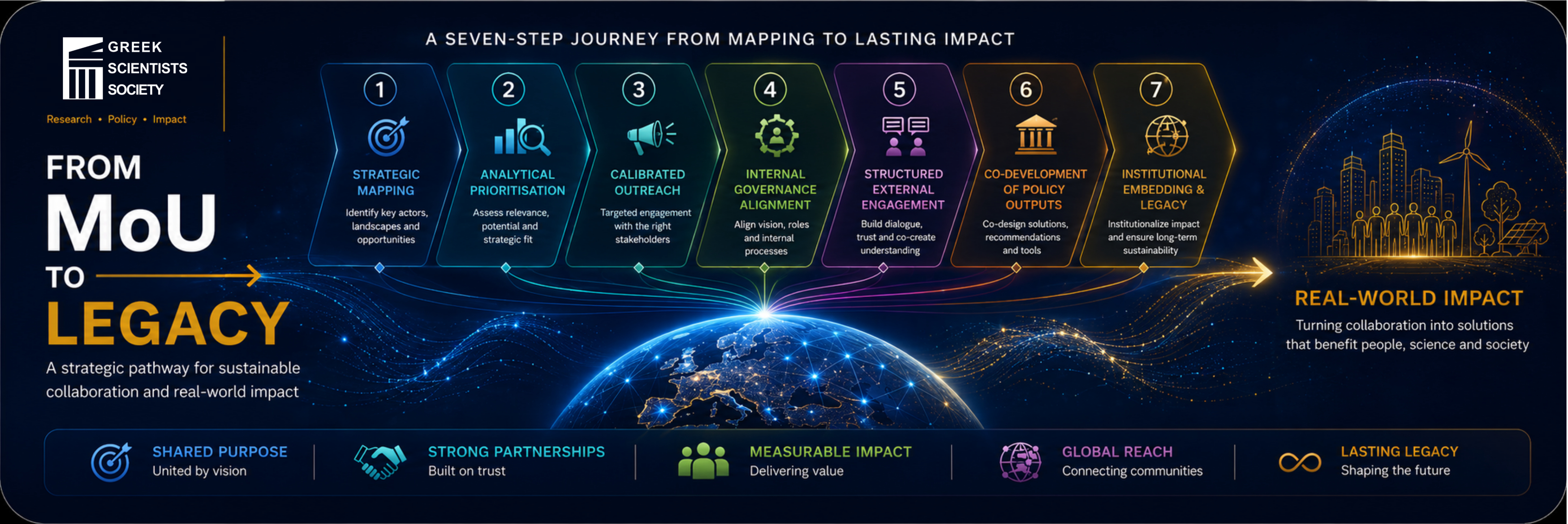
A new strategic approach
A strategic pathway from a signed agreement to results that reach people, and to a legacy that outlives the mandate.
Most networks engage stakeholders. Comparatively few convert that engagement into something an institution can pick up and carry. The difference is rarely effort or goodwill. It is sequence.
This approach sets out a structured and replicable pathway, from strategic mapping through to institutional embedding, designed to strengthen the policy impact, dissemination and sustainability of a research network. It is adaptable across research domains and scalable across grant periods.
The familiar pattern runs meeting, discussion, report, archive. Each stage is competently executed and the sequence ends where it started, with a document that few people outside the network will ever act on. The approach set out here replaces that pattern with a sequence designed to end somewhere else.
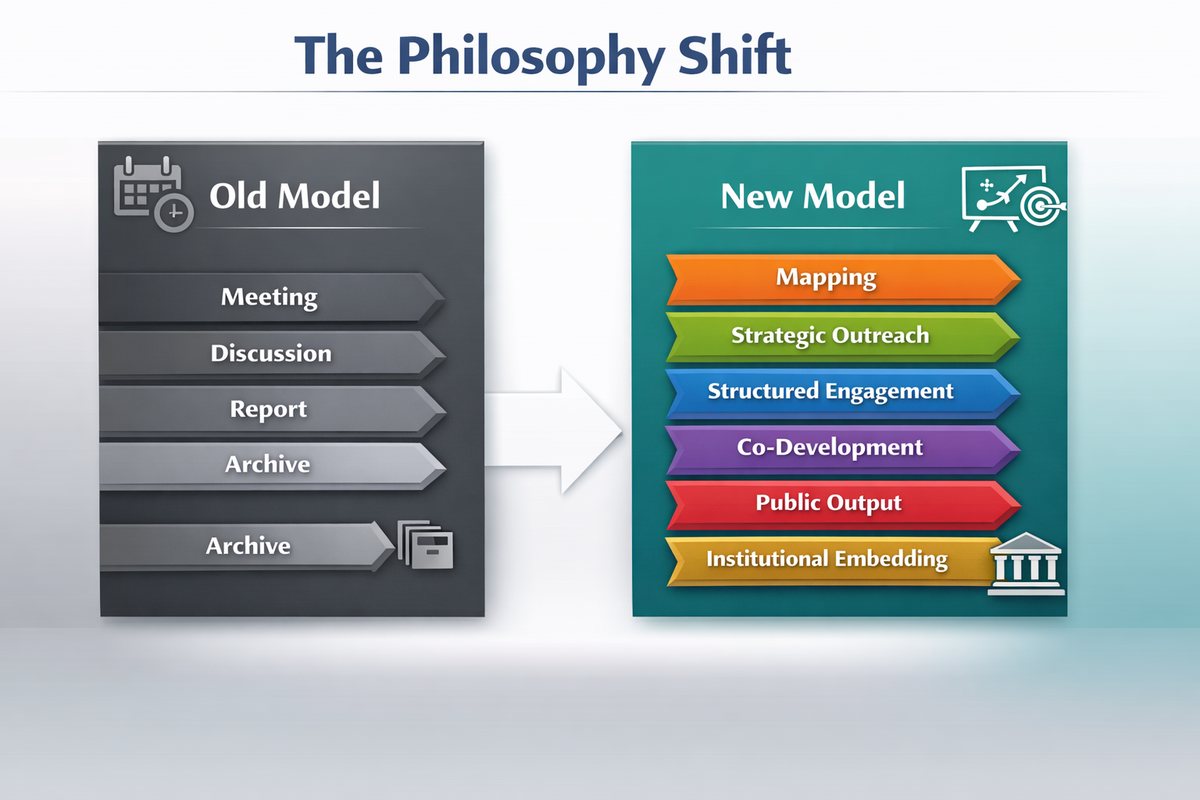
The objective is not participation. It is structured co-development, policy translation and long term legacy. Each of the seven steps that follow produces a defined output, and each output is the input to the step after it, which is what keeps the sequence from dissolving into activity.
Two commitments hold the whole approach together. The first is that engagement is calibrated rather than broad: the question is not who might be interested, but who shapes decisions, standards, funding, implementation and narrative, and where mutual value can be created. The second is that dialogue is expected to produce a usable product with named co-authors, since co-authorship is what turns interest into ownership.
Applied to a COST Action, the approach aligns with existing obligations rather than adding to them. Its outputs map onto policy briefs, strategic reports and white papers, and its engagement moments can be embedded within Action meetings, Training Schools or dedicated stakeholder workshops.
The order carries most of the value. Outreach before analysis produces invitations rather than positioning. External engagement before internal alignment dilutes the network's own message. Production before validation produces documents that address a problem nobody confirmed.
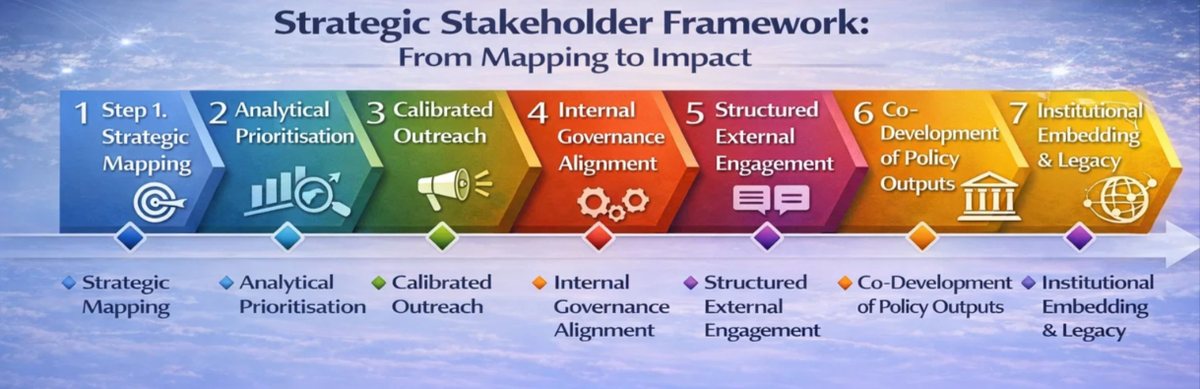
Each step below states its purpose, the work it involves and the output it produces. The examples are published applications of the step in live COST Actions.
Strategic mapping. Establish who exists in the field around the network, and on what basis each of them matters.
Identify the policy or strategic domains at stake, the regulatory and institutional relevance of each actor, the level of governance they operate at (European, national, regional, agency, standards body), their influence set against their interest, and the potential for alignment.
In practice. Structured multi-sector mapping and role differentiation: Chartering Sustainability Pathways for CA22160 BioAqua.
Once stakeholders are mapped, analysis determines how and when to engage them. This is the move from identification to prioritisation.
The question shifts from who should we invite, to who shapes decisions, standards, funding, implementation and narrative. And, just as importantly, where can mutual strategic value be created.
In practice. How structured categorisation strengthens policy alignment: Enhancing Stakeholder Engagement for Climate Resilience, CA21166 SHiFT.
GSS built this knowledge graph so that an Action can see its nearest neighbours: the other Actions working adjacent problems, across cohorts and panels. It is a practical way to identify partners and alliances, to find who is worth inviting to a stakeholder meeting, and to spot the Actions with which a joint endeavour would carry more weight than a solo one.
COST Action Interdisciplinarity Graph · full screen · DOI: 10.5281/zenodo.22141909 · Greek Scientists Society
The bridge between analysis and engagement. Outreach here is not an invitation, it is calibrated positioning.
Before any external contact, the network answers five questions: what is the concrete objective, what problem is being addressed, what is the specific ask, what do stakeholders gain by engaging, and why now, in terms of policy timing, consultation or review cycles.
Before the first external engagement, the network aligns internally. This step establishes the governance structure and the accountability mechanisms that give the engagement coherence and credibility.
Internal clarity is what prevents external dilution. This is the design phase, not yet the public facing event.
The first calibrated interaction with selected stakeholders. The objective is not broad consultation, it is structured validation and prioritisation. The engagement can be embedded within Action meetings, Training Schools or a dedicated stakeholder workshop.
This meeting does not aim to solve everything. It defines the pathway forward.
In practice. Governance design and engagement structuring before outreach: Stakeholders Analysis, CA21111 OneHealthDrugs.
The step that converts dialogue into impact. Many initiatives stop after engagement. This is where the approach moves into structured production, transforming validated discussion into a concrete and usable output.
The working method is modest and disciplined: two or three structured interim meetings, shared drafting responsibilities, version control and feedback loops, and clear decision checkpoints.
In practice. Exploitation strategy, co-authorship as ownership: EU-PoTaRCh as a Policy Bridge, CA22155.
This phase ensures the output does not remain an internal document. A brief internal evaluation of process effectiveness and stakeholder responsiveness belongs here too.
The objective throughout is insertion into decision channels rather than symbolic visibility.
Indicative rather than prescriptive. The early steps compress easily where a network already knows its field. The later ones rarely do, since co-development and institutional uptake move at the pace of the institutions involved.
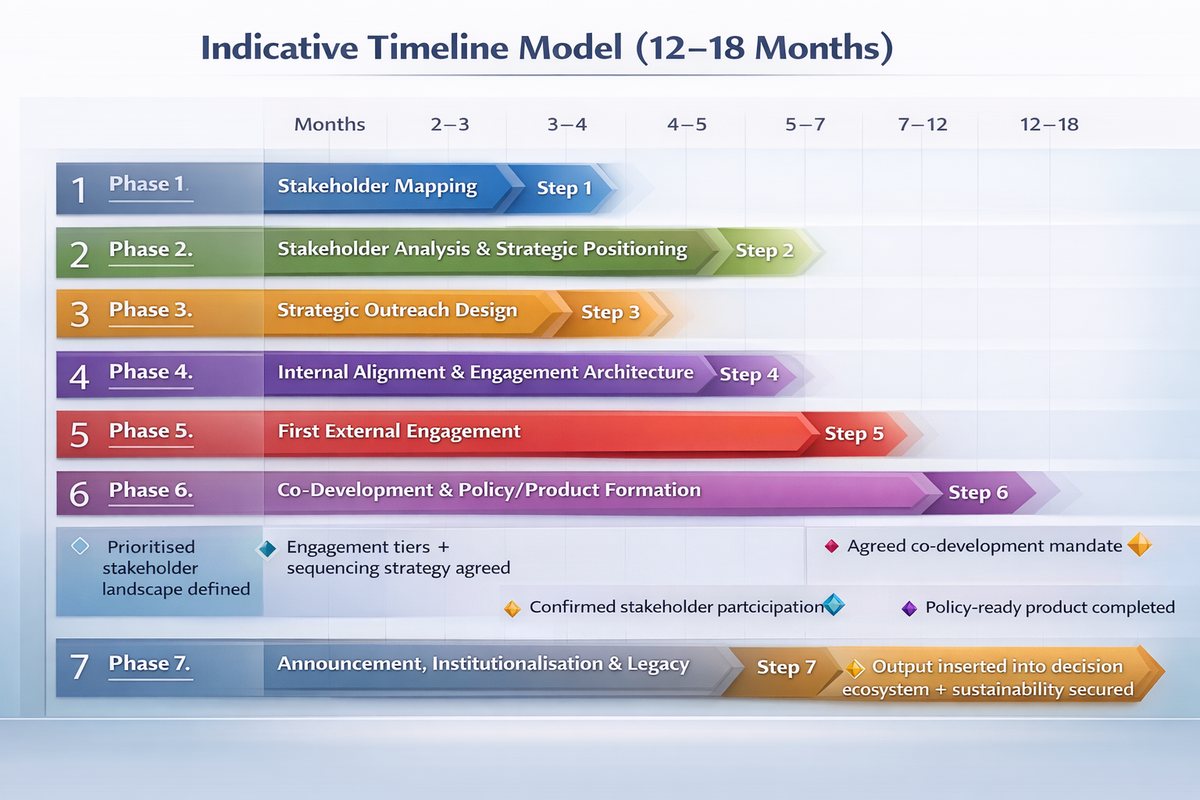
Legacy is the point of the sequence, not an epilogue to it. The measure is whether the relationship survives the mandate that created it.
From temporary engagement to a structured, recurring regulatory dialogue channel. From project based interaction to a recognised policy interface. Both are descriptions of the same change: the network stops being an event and starts being an address.
A light stakeholder advisory mechanism, the topic carried into the next Grant Period, and links to follow up initiatives keep the work alive while the Action runs. Beyond it, continuity has to be anchored in an entity that outlives the mandate.
Post-Action Sustainability Projects (PASPs), a concept introduced by Theo Zacharis, Greek Scientists Society, are the structure that carries an Action’s work forward once the mandate ends. Kinesis Innovation Center is the first of them, established out of COST Action CA20104 PhysAgeNet.
Three published components address three different questions. They can be adopted separately and tend to work best in sequence.
The sequence. How a network moves from stakeholder mapping through co-development to institutional embedding, and what each step is expected to produce.
The structure. How the intelligence a consortium already holds is made visible, positioned on the quadruple helix, and treated as capital that can be converted.
The working form of the framework: five layers over one taxonomy, deployable for any Action, with the same architecture across cohorts and domains. Documented in From Mapping to Impact.
A framework describing the exchange itself, and an operational approach for running this across several Actions. Neither is published yet.