Greek Scientists Society / Methodology series · Start here
Contents
Series01From MoU to LegacySeries02From Mapping to ImpactSeries03The Innovation Atlas

Start here

One aim, three frameworks

Turning a funded network into capability that outlives the mandate.

The aim of the series is one thing: that when an Action ends, something remains. Not only publications, but relationships an institution has taken up, a picture of what the network can do, and a route for someone else to carry it on.

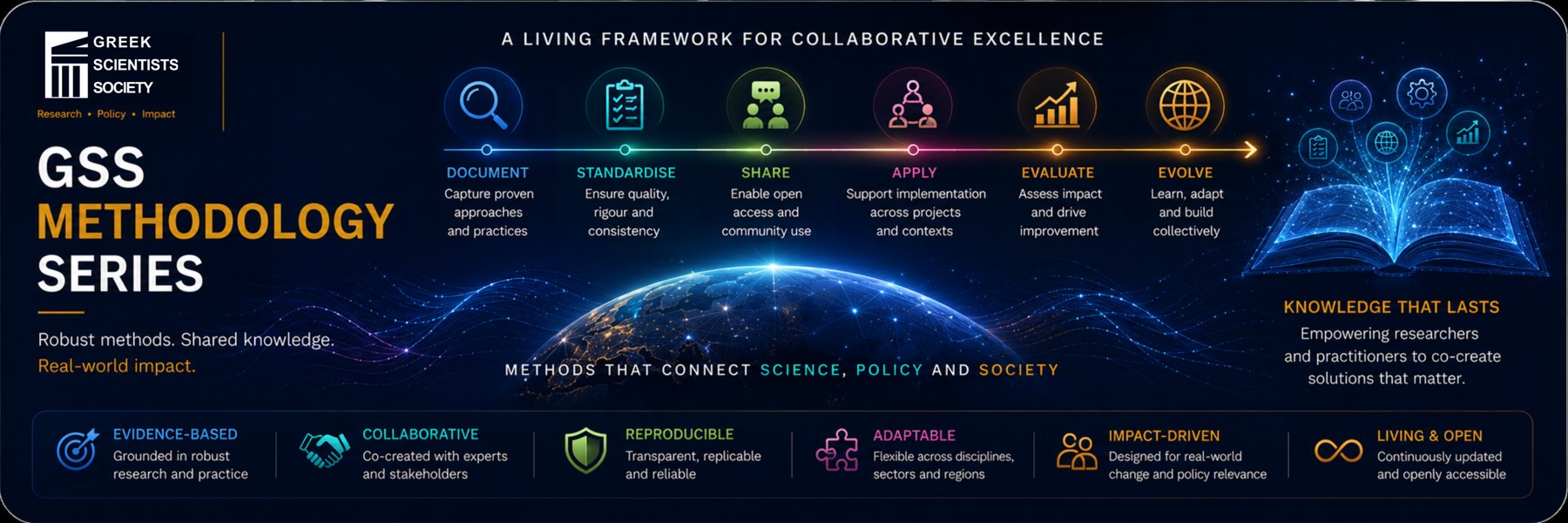
Three frameworks serve that aim from three directions. One gives the network a sequence to follow. One gives it a clear view of who matters and why. One gives it a shared record of what it holds. Each stands alone, each has been applied in live COST Actions, and all three are published openly for any network to use.
Frameworks Three published For COST Actions and research consortia Scope Domain agnostic Licence CC BY-SA 4.0
01 / The aim

That the work outlives the Action that produced it.

A network is funded for a fixed period and judged, in the end, on what carried beyond it. The series exists to make that outcome deliberate rather than fortunate, and it does three things to bring it about.

It gives a sequence

An order of work

From identifying who matters, through calibrated outreach and internal alignment, to a co-developed output and its uptake by an institution. Each stage produces something the next one needs, so engagement accumulates instead of restarting.

It makes capability visible

A view of the network

Expertise, facilities, data and the trust members hold with actors outside the academy, gathered into one place the whole Action can consult. Members find each other, gaps become obvious, and newcomers become useful quickly.

It leaves something behind

A route to continuity

Custodianship arranged while the mandate still exists: a named holder, a versioned record, and relationships attached to institutions rather than to individual inboxes.

For a Chair or a coordinator, the practical question is usually narrower: what does this add to a consortium already running. In most cases it adds a defensible account of stakeholder work for the reporting that is coming, a way of assembling proposal and mobility teams from evidence, and a plan for the final year that does not have to be improvised in the final year.

02 / Three frameworks

Three axes, one aim.

Each framework is published in full as an open page. They were built in the order a network needs them, tested in live COST Actions, and written to apply to any funded research consortium.

What connects them

The three are not variations on one idea. Each runs along a different axis, which is why a network can need more than one.

From MoU to Legacy is the time axis. What happens in what order, and what survives the mandate once the funding stops.

From Mapping to Impact is the structure axis. Who is in the system, how they are positioned, and which of them shapes decisions rather than merely attending.

The Innovation Atlas is the record axis. What the network holds, organised so that it can be consulted, added to and handed on. It is a framework in its own right, with its own architecture of five layers, and it is also the working instrument in which the other two leave their results.

Between them the three cover a great deal and leave one thing out. None describes the exchange itself: what actually happens when a capability in one country and a need in another are brought together.

01
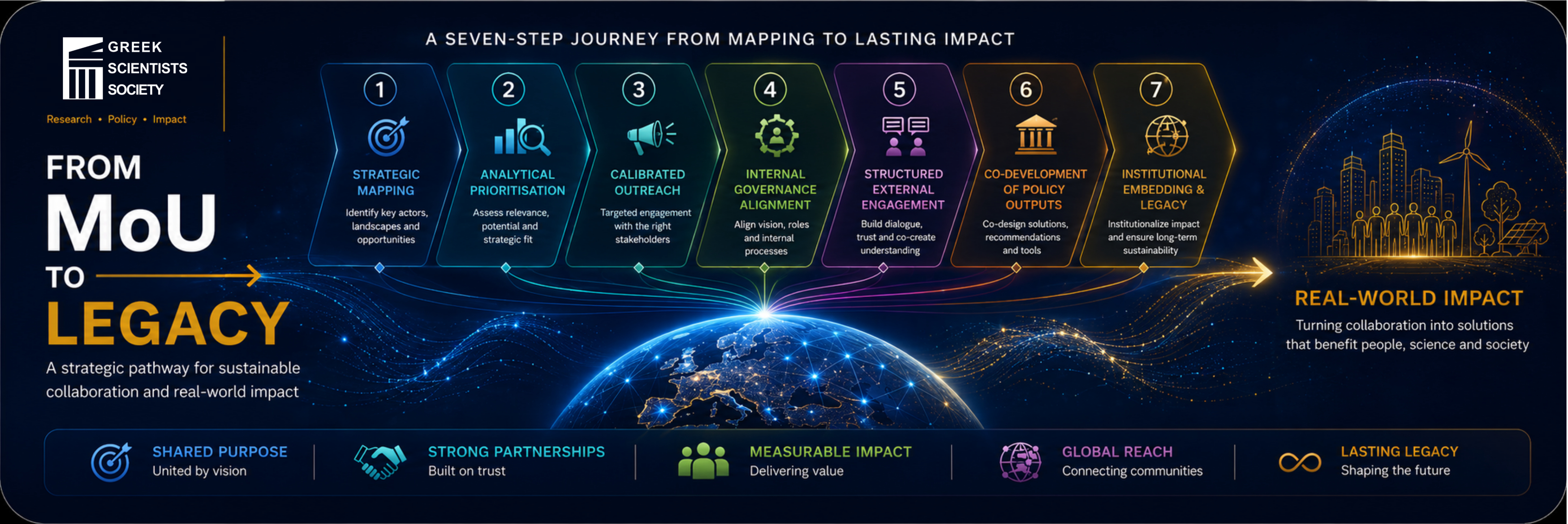
From MoU to Legacy: a seven step journey from mapping to lasting impact.

From MoU to Legacy

What has to happen, and in what order?

The sequence. Seven steps from stakeholder mapping through analysis, calibrated outreach and internal alignment, to co-development of a policy output and its embedding in an institution. Each step states the output it hands to the next, which is what keeps engagement from dissolving into activity.

Read the framework

02
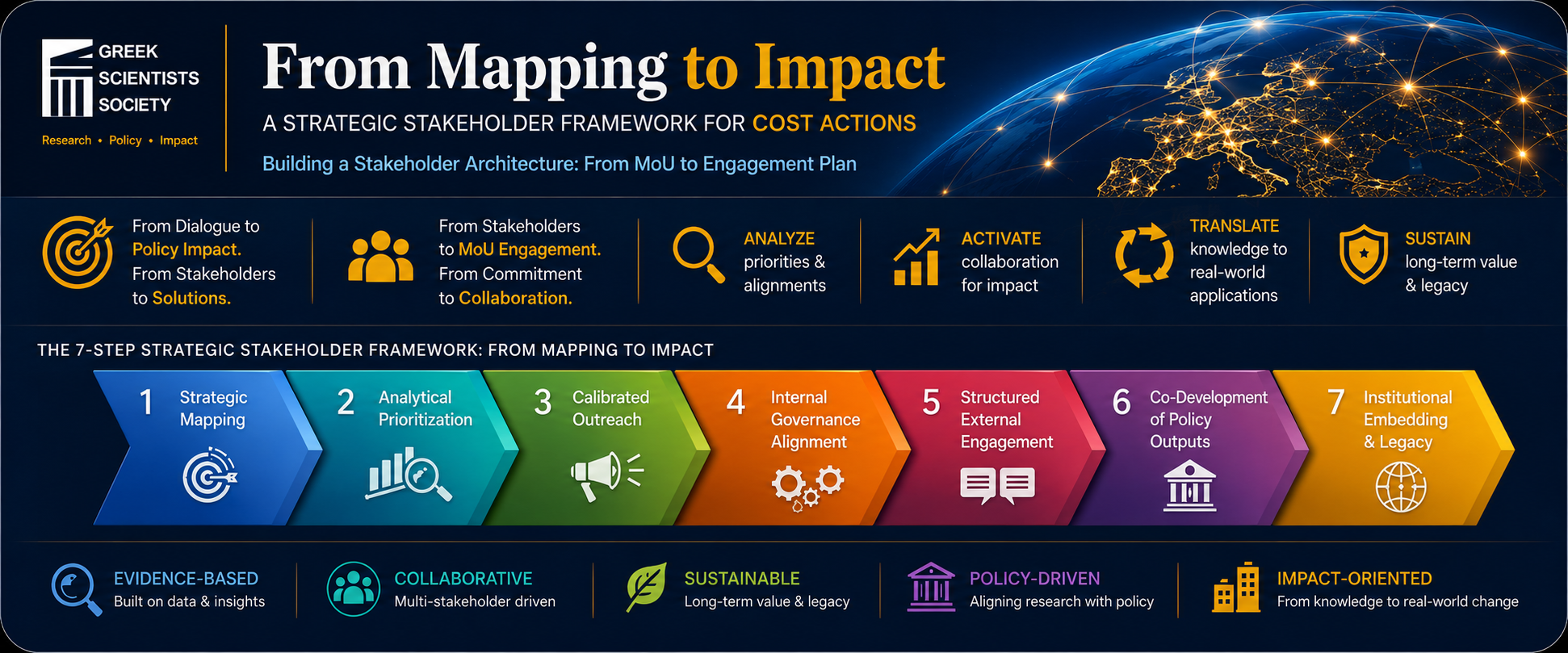
From Mapping to Impact: a strategic stakeholder framework.

From Mapping to Impact

Who is in the system, and where do they sit?

The structure. A method for turning a stakeholder list into a prioritised, MoU anchored engagement plan, with every entry traced to a section of the agreement and scored by a team rather than by one person. This is where a network decides who shapes decisions, and who is merely present.

Read the framework

03
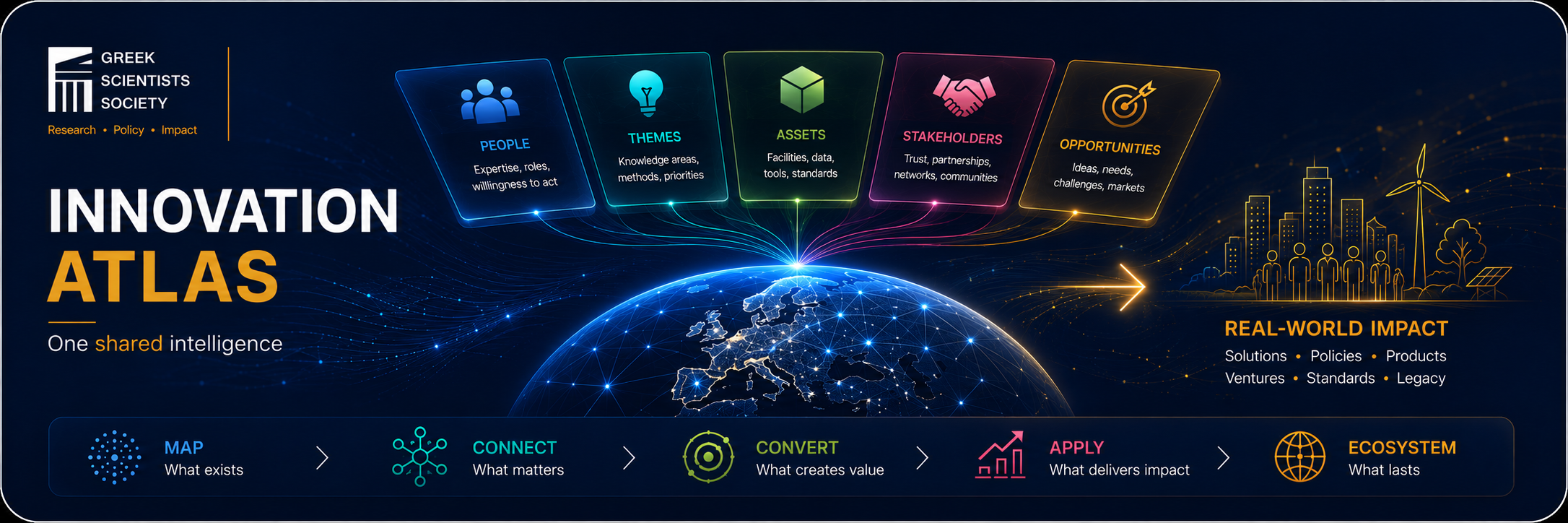
Innovation Atlas: five layers, people, themes, assets, stakeholders and opportunities, converging over a networked globe toward real-world impact.

The Innovation Atlas

What does the network hold, and where does it live?

The record. A framework of five layers over one taxonomy: people, themes, assets, stakeholders and opportunities, treated as capital that can be converted rather than as a directory. It is also the instrument the other two frameworks write into, built once, maintained by the members, and designed so the same architecture works across domains and cohorts.

Read the framework

03 / Where to start

Adopt one, or run all three.

The frameworks are independent by design, because few networks are in a position to take on three things at once. The table below reads in series order, with the moment each one is easiest to adopt.

FrameworkBest moment to adoptWhy then
01 From MoU to LegacyAt the start, and again in the final yearIt sets the order of work for the whole mandate, and its last step arranges custodianship, including a Post-Action Sustainability Project (PASP), while the funding still exists to organise it.
02 From Mapping to ImpactWhile the agreement is freshThe register comes straight out of the MoU, so the work is at its easiest and it shapes every engagement that follows.
03 The Innovation AtlasOnce the network has members and momentumIt is the fastest way to see what the consortium already holds, and the gaps it exposes are usually the finding.

Run together, the order is straightforward. The sequence tells you what happens when, the structure tells you who it matters to, and the record holds what the network learns so that the next coordinator does not begin from nothing.

04 / Principles

What holds across all three.

Agnostic

No platform, no discipline

Nothing here assumes a vendor, a tool or a field. The frameworks have been applied, or can be applied, across health, environment, energy and agri-food. The Atlas is the newest of the three and is built on the same thin architecture, so it transfers on the same terms.

Owned by members

Contributed, not collected

Members correct the records that concern them, and add the stakeholders whose relationships they hold. Contributions and suggestions are reviewed by a moderator before publication, and the source stays with the record.

Open

Published to be reused

The frameworks, the taxonomy each network builds, and the GSS data model behind the Atlas are all published, so they can be audited, adapted and compared. A method that cannot be inspected is a service, not a method.

05 / What comes next

Two layers in development.

The layer above

Convergence

Time, structure and the record are covered. The exchange itself is not: what happens once a map shows that a capability in one country and a need in another have not yet met. Convening the two, framing an offer each side recognises, and agreeing who owns what if it works.

The layer beneath

Resource planning

A framework is only as good as an Action’s capacity to run it. This layer covers the planning of the resources a single Action actually has: budget across grant periods, mobility and mission instruments, meeting time, and who inside the network carries which task. It is what turns a method into something a coordinator can schedule.

The aim

From one Atlas to many.

One Atlas serves one network. Many Atlases on one architecture would begin to behave as a single ecosystem: adjacent Actions able to find each other, capability visible wherever it sits, and conversion happening between networks rather than inside one.

The aim is to support European science in finding its place in a global setting, and the Atlases are a first step toward it. An ecosystem is built one connected map at a time. That is the direction of the work, rather than a description of where it stands today.